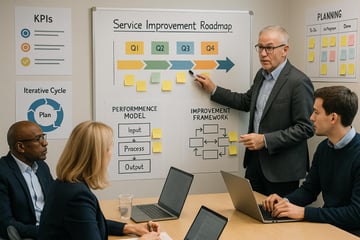
Driving project success today demands more than rigid plans—it requires adaptability, collaboration, and iterative improvement. Participants will learn to apply Agile Scrum techniques to manage complexity and uncertainty across project lifecycles. They will engage in real-world simulations to practise sprint planning, backlog grooming, and team facilitation.
Learning Outcomes:
Apply Scrum techniques to manage evolving project requirements
Facilitate sprint planning, reviews, and retrospectives
Prioritise tasks and maintain effective backlogs
Use agile metrics to track progress and adapt delivery
Improve team collaboration and stakeholder alignment
Key Topics:
Scrum roles and responsibilities
Sprint planning, reviews, and retrospectives
Backlog refinement and prioritisation methods
Agile performance metrics and burn-down charts
Conflict resolution and agile team dynamics
FUNDING INFORMATION
SkillsFuture Singapore (SSG)
Funding is available on Course Fee. Please see below for the eligibility categories available.
| Self-sponsored | Singapore Citizen & PR aged ≥ 21 years | Up to 50% funding |
| Singapore Citizen aged ≥ 40 years | Up to 70% funding | |
| Company Sponsored (Non-SME) | Singapore Citizen & PR aged ≥ 21 years | Up to 50% funding |
| Singapore Citizen aged ≥ 40 years | Up to 70% funding | |
| Company Sponsored (SME) | Singapore Citizen & PR aged ≥ 21 years | Up to 70% funding |
| Singapore Citizen aged ≥ 40 years | Up to 70% funding |
SSG Funding Requirements
- Trainees must scan their attendance twice daily using the SingPass application.
- Trainees must attain at least 75% attendance.
- Trainees must pass the in-house assessment to be eligible for funding.
- Trainee and/or sponsoring company is/are required to meet all SSG-mandated eligibility criteria and requirements for funding. For more information, please refer to SkillsFuture homepage.
Appeal Policy and Procedure
- As a candidate in this course assessment, you may appeal your results if you disagree with them.
- To do so, submit your written appeal request via email to esv_comat_cse@stengg.com within 3 working days from date of assessment.
Cancellation, Postponement and Refund Policy
- Request for cancellation or postponement must be submitted in writing more than 4 weeks before the class start date to avoid any charges.
- Written notice for cancellation or postponement received 2 to 4 weeks before class start date will incur Late Cancellation Charge - 50% of course fee.
- Written notice for cancellation or postponement received less than 2 weeks before class start date will incur Late Cancellation Charge - 100% of course fee.
- If payment has been made and ST Engineering e-Services Pte Ltd accepts the trainee's written notification to cancel or withdraw from the course, ST Engineering e-Services Pte Ltd will issue a refund, less any applicable Late Cancellation Charges.
Feedback Policy and Procedure
- You may submit feedback via email to esv_comat_cse@stengg.com or your servicing Account Manager.
- Any formal feedback will be handled within 10 working days from receipt with a written reply given. An interim reply will be provided should more time be required.
Module 1: Introduction to Agile and Scrum
- Understand the Agile Manifesto
- Principles and values of Agile
- Overview of Scrum framework
- Benefits of Scrum and Agile methodologies
Module 2: The Agile project planning and roadmap
- The Scrum Roles and Responsibilities
- Release Planning and Roadmap
- User Stories and Product Backlog Refinement
- Story Points estimation
Module 3: Application of Scrum events, Scrum artifacts and Scrum task-board
- Sprint Planning
- Daily Scrum
- Sprint Review
- Sprint Retrospective
- Product Backlog
- Sprint Backlog
- Definition of Done
- Scrum task-board
Module 4: Track and monitor Agile project with risk mitigation
- Sprint Execution and Backlog Management
- Tracking Progress with Burndown/Burnup Charts
- Managing Change and Adaptation
Module 5: Agile collaboration and communication, agile leadership and culture
- Facilitating Effective Meetings
- Communication Techniques in Agile Projects
- Collaborative Decision Making
- Agile Leadership Principles
- Building an Agile Culture




.png?width=50&name=Artificial%20Intelligence%20(AI).png)









































































-1.png?width=360&name=Server%20(4)-1.png)






/AI%20(6)-1-1.png?width=360&name=AI%20(6)-1-1.png)
/AI%20(8)-1.png?width=360&name=AI%20(8)-1.png)
-1.png?width=360&name=Automation%20RPA%20(2)-1.png)
/AI%20(5)-1.png?width=360&name=AI%20(5)-1.png)