Strategy without execution is just wishful thinking. This intensive three-day course equips participants with the mindset, tools, and structured frameworks to bridge the gap between strategic planning and measurable business results. They will learn to translate coherent strategy into actionable project portfolios, align execution with KPIs, and lead initiatives that enhance organisational capability.
Learning Outcomes:
Understand the root causes of strategic implementation failure
Apply tools to derive and implement coherent strategies
Align vision, mission, and values to execution plans
Develop enterprise balanced scorecards linked to KPIs
Evaluate leadership styles for project execution
Design cascaded goals and accountability models
Key Topics:
Success factors and barriers in strategy execution
Eight integrated strategic planning tools
Conversion of strategy into prioritised project portfolios
Balanced Scorecard development and implementation
The ‘eight fits’ model for execution: strategic, leadership, cultural and more
Leadership models: team, transformational, authentic
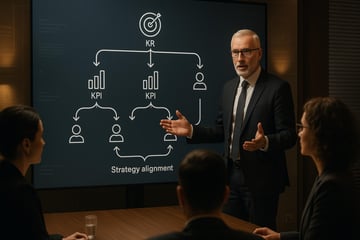
Stakeholder alignment and KPI cascade through the S-I-O chain
Six execution processes: Awareness, Alignment, Action, Adoption, Assurance, Anticipation
The 3-day action learning workshop covers from deriving the right coherent strategy, to executing the coherent strategy by converting into projects, through to getting the business results.
Strategize
- The development of a coherent strategy needs to address 4 key success factors in strategy execution, i.e. clarity in planning, converting strategy into achievable targets, prioritization of resources, and excellence in execution support.
- There are 4 barriers that hinder the successful execution of a strategy, i.e. inadequate strategic planning, speed of strategic decisiveness, frequency of environmental turbulence, speed of organizational responsiveness.
- Holistic approach to strategic planning using 8 proven integrated tools to derive a coherent strategy.
- Case illustration and action learning practice by participants.
Implement
- The effectiveness of successful implementation of a coherent strategy is measured by an enterprise balance scorecard incorporating innovation and growth, internal business processes, customer experience, and sustainable financial performance.
- Converting strategy into prioritized projects need to go through the 8 fits, i.e. strategic, leadership, structural, cultural, capability, organizational development, communications, and technology.
- Discipline in execution is crucial to project. Project leadership is accountability, i.e. process ownership to get the job done. Ability to execute requires the organization to create a common language for work. Technology enhances the speed of execution.
- There are 3 types of leadership for successful execution of strategy through projects, i.e. team leadership for light-weight project, transformational leadership for medium weight-project, and authentic leadership for heavy-weight project. Leadership is critical to energize and lead the team to thrive for stretched targets.
Operate
- The effectiveness of human capital development in translating strategy into action advantage is measured by KPIs reflecting on individual’s and team’s targets that are attainable and aligned to the coherent strategy.
- There are 6 key processes to ensure the business results of revenue growth, liquidity, and profitability, i.e. awareness, alignment, action, adoption, assurance, and anticipation of risks to strive and thrive for the vision.
- Consistency in the people’s behaviour in the S-I-O chain is the chief success factor to attain a high performance culture, i.e. values drive behaviours, and behaviours drive results.
- Construct the coherent strategy map to permeate the projectised organization to minimize conflict and communication barrier.






.png?width=50&name=Artificial%20Intelligence%20(AI).png)







/AI%20(5)-1.png?width=360&name=AI%20(5)-1.png)










































































-1.png?width=360&name=Server%20(4)-1.png)






/AI%20(6)-1-1.png?width=360&name=AI%20(6)-1-1.png)
/AI%20(8)-1.png?width=360&name=AI%20(8)-1.png)
-1.png?width=360&name=Automation%20RPA%20(2)-1.png)