*Important Note : Fees are subject to Singapore's prevailing Goods and Services Tax (GST).
1752451200000
60

Cloud & Infrastructure
Cybersecurity & Risk Management
Artificial Intelligence & Automation
Data Analytics & Data Science
Digital Skills & Office Productivity
Project Management & Agile
Software Development & IT Ops
Critical Core Skills
Maritime
Cloud & Infrastructure
Cybersecurity & Risk Management
Artificial Intelligence & Automation
Data Analytics & Data Science
Digital Skills & Office Productivity
Project Management & Agile
Software Development & IT Ops
Critical Core Skills
Maritime
 Thinking Critically
Enrol now and save $0 on your course fee
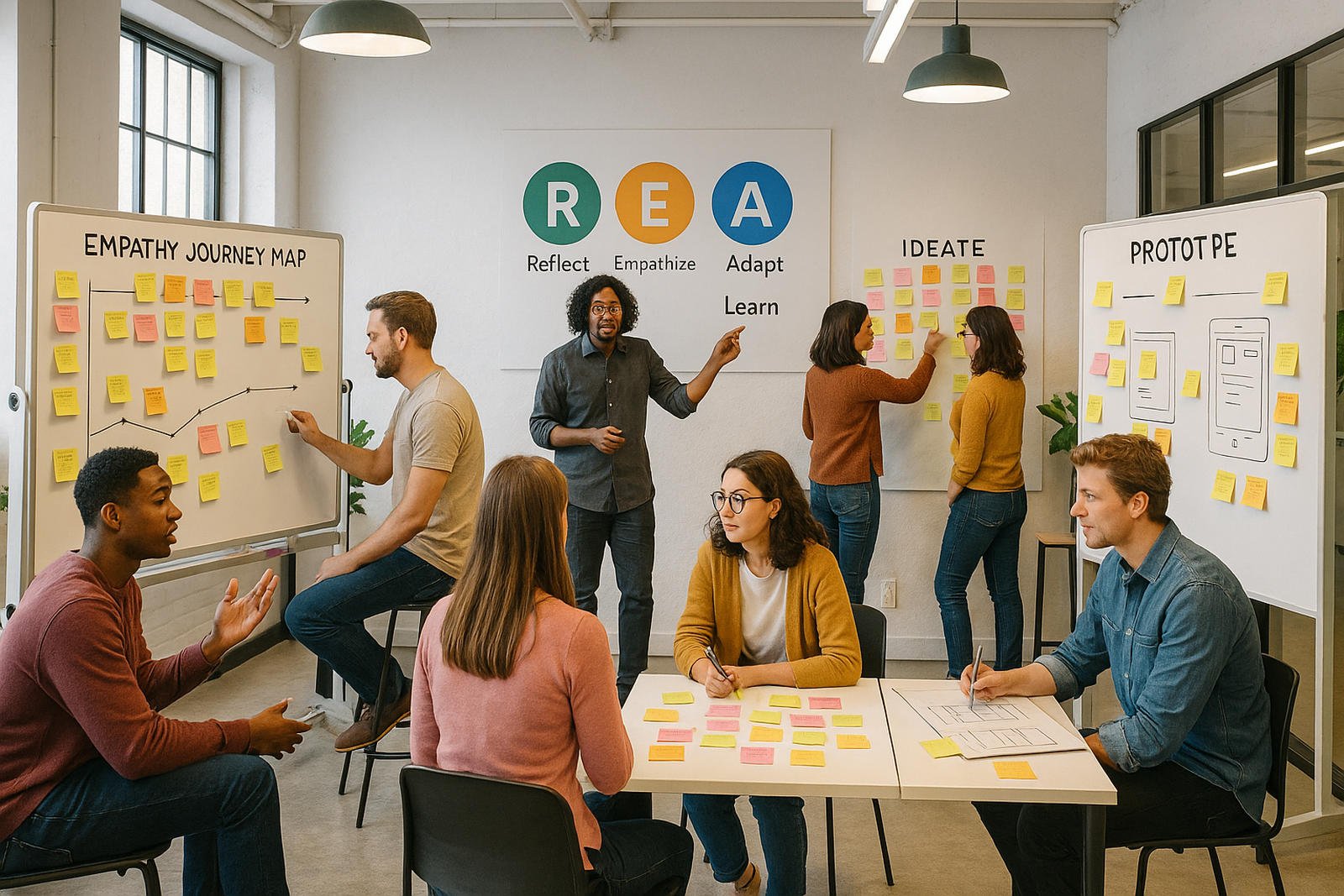
Design thinking transforms how problems are solved by focusing on empathy, creativity, and experimentation. Participants will learn to apply the R.E.A.L (Relatable, Empathetic, Actionable, Lasting) framework to drive innovation and user-centred solutions. Through hands-on modules, they will explore need-finding, ideation, prototyping, and storytelling strategies.
Learning Outcomes:
Understand the principles and mindset behind design thinking
Apply empathy mapping and user research techniques
Develop and prototype user-centric solutions using the R.E.A.L framework
Facilitate ideation workshops and storytelling for impact
Evaluate solution effectiveness through iterative feedback
Key Topics:
Design thinking fundamentals and the R.E.A.L model
Human-centred research and empathy tools
Ideation and rapid prototyping techniques
Storytelling and influence in design
Facilitating creative collaboration sessions
Day 1: AM : Recognise Empathy in the Being
1. How to apply perspective taking for problem-solving?
2. How to bring the “design thinking” ideology to systems thinking?
3. Learn to apply the steps of problem-solving process to overcome challenges/issues
Day 1: PM: Finding the Right Balance to Decision-making
4. Explore and examine divergent and convergent thinking to foster ideation processes
5. How can you apply divergent and convergent thinking to creative problem-solving skills?
6. How to increase body awareness to one's posture and movement with somatic techniques?
Day 2: AM: Creating Shared Meaning by Thinking Right
7. How to critically think by asking the right questions?
8. How to develop effective empathetic communication skills?
9. The role of having divergent and convergent thinking skills
Day 2: PM: Developing the Art of Feedback in Communication
10. Recognising barriers to feedback
11. How to develop trust and confidence in a relationship with feedback?
12. How to ask for feedback in an email?
Day 3: AM: Building Mentoring Relationship in the Workplace
13. How to build a culture of empathy with different personality types?
14. Learning the importance of empathy as a cornerstone in the workplace
15. How to allow time for compassionate reflection and response?
Day 3: PM: Developing an Inclusive Design within the workplace community
16. How to break the cycle of exclusion?
17. Learning the importance of managing diversity to maximise one’s potential
18. How to use design thinking to create a human-centric approach to performance management process?
We’re here to help — reach out anytime.
By submitting this form, you consent to be contacted via email and/or your mobile number regarding your enquiry. You consent to the collection, use, disclosure and processing of your personal data in accordance with our Personal Data Policy.



.png?width=50&name=Artificial%20Intelligence%20(AI).png)


/AdobeStock_230441943.jpeg?width=360&name=AdobeStock_230441943.jpeg)

/AdobeStock_737314510.jpeg?width=360&name=AdobeStock_737314510.jpeg)






/AI%20(5)-1.png?width=360&name=AI%20(5)-1.png)





































































-1.png?width=360&name=Server%20(4)-1.png)





/AI%20(6)-1-1.png?width=360&name=AI%20(6)-1-1.png)
/AI%20(8)-1.png?width=360&name=AI%20(8)-1.png)
-1.png?width=360&name=Automation%20RPA%20(2)-1.png)




















































![VMware vRealize Operations: Install, Configure, Manage [V8.6]](https://www.eservtraininghub.com/hs-fs/hubfs/331_result.jpg?width=360&name=331_result.jpg)
![VMware vRealize Automation - Install, Configure, Manage [V8.3]](https://www.eservtraininghub.com/hs-fs/hubfs/AI-Generated%20Media/Images/Automation%20system%20deploying%20infrastructure%20in%20realtime%20with%20robotic%20arms%20and%20config%20lines%20building%20digital%20components%20Blue%20enterprise%20tech%20setting.jpeg?width=360&name=Automation%20system%20deploying%20infrastructure%20in%20realtime%20with%20robotic%20arms%20and%20config%20lines%20building%20digital%20components%20Blue%20enterprise%20tech%20setting.jpeg)















































![VMware vSphere: Install, Configure, Manage [V8]](https://www.eservtraininghub.com/hs-fs/hubfs/756_result.jpg?width=360&name=756_result.jpg)









![VMware NSX: Install, Configure, Manage [V4.0]](https://www.eservtraininghub.com/hs-fs/hubfs/812_result.jpg?width=360&name=812_result.jpg)