*Important Note : Fees are subject to Singapore's prevailing Goods and Services Tax (GST).
undefined
60

Cloud & Infrastructure
Cybersecurity & Risk Management
Artificial Intelligence & Automation
Data Analytics & Data Science
Digital Skills & Office Productivity
Project Management & Agile
Software Development & IT Ops
Critical Core Skills
Maritime
Cloud & Infrastructure
Cybersecurity & Risk Management
Artificial Intelligence & Automation
Data Analytics & Data Science
Digital Skills & Office Productivity
Project Management & Agile
Software Development & IT Ops
Critical Core Skills
Maritime
.png?width=22&height=21&name=Artificial%20Intelligence%20(AI).png) Artificial Intelligence
Artificial Intelligence
/AI%20(5)-1.png?width=500&height=288&name=AI%20(5)-1.png)
Enrol now and save $0 on your course fee
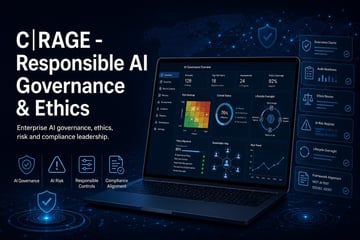
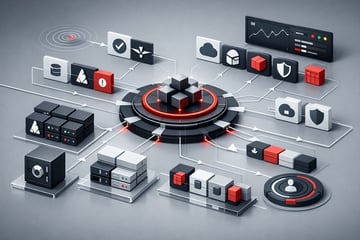
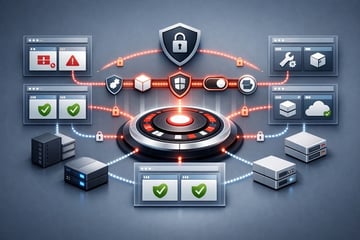
Enterprises are deploying AI at speed, increasing exposure across data, models and third-party ecosystems. This course equips participants to structure governance, quantify risk and apply effective controls so AI delivers value without compromising security. They will work through modules on programme governance, risk management, and technical controls, using scenarios, practical exercises and management reporting to translate policy into operational results, guided by experienced trainers.
Learning Outcomes
Key Topics
Exam Details
This course is designed to build participants’ understanding of key concepts and domains covered in the ISACA Advanced in AI Security Management (AAISM) certification.
To maximise success, participants are strongly encouraged to complement the course with additional self-study, revision of course materials, and dedicated practice before attempting the exam.
1) AI Governance and Programme Management
A. Stakeholder considerations, industry frameworks, and regulatory requirements
Organisational structure and overall governance
Roles and responsibilities
Charter and steering committee
Identifying stakeholders
Risk appetite and tolerance
Frameworks, standards, and regulations; selecting appropriate frameworks
Business and use cases for AI
Privacy considerations
B. AI-related strategies, policies, and procedures
AI strategy (consumer vs enterprise; buy vs build)
Policies: responsible use, acceptable use
Procedures: implementation, manuals
Ethics
C. AI asset and data lifecycle management
AI asset and data inventory (inventory management, model cards)
Data handling, classification, discovery
Data augmentation and cleaning; storage; protection; destruction
D. AI security programme development and management
Documented programme plan
Security team roles, responsibilities, proficiencies
Alignment to existing information security
Use of AI-enabled security tools
Metrics and management (KRIs, KPIs)
Management reporting
E. Business continuity and incident response
Detection, notification, classification (criticality/severity)
Resiliency; Business Continuity Plan
Compliance “red-button” requirements
AI-specific incident response playbooks
Break-glass / go-no-go; authority
RTO/RPO from an AI perspective
Disaster recovery; testing
2) AI Risk Management
A. AI risk assessment, thresholds, and treatment
Impact and conformity assessments; PIAs; documentation
Acceptable risk levels; treatment plans
KRIs and KPIs for AI use
B. Threats, testing, and assurance
Penetration testing; vulnerability testing; red teaming
AI-related vulnerabilities; adversarial threats
Threat intelligence; AI-enabled attack chains; anomalies; landscape
Deepfakes; insider threat; AI agents
C. AI vendor and supply-chain management
Software/library dependencies
Vendor due diligence and contracts; SLAs; usage
Accountability models (provider vs deployer)
Third/fourth/fifth parties; ownership/IP; access controls; liability
Vendor monitoring for risk/changes
3) AI Technologies and Controls
A. Security architecture and design
Change management; SDL; secure-by-design
Securing infrastructure as code
Data flows; approved base models
Interconnectivity with architecture
B. AI lifecycle (model selection, training, validation)
Testing model interconnectivity; linkages between models
Regression/progression; model testing; TEVV
Model accuracy testing and evaluation
C. Data management controls
Data collection and control
Data poisoning; bias; accuracy
Data position/possession requirements
D. Privacy, ethical, trust & safety controls
Explainability; privacy controls (e.g., right to be forgotten, data subject rights)
Consent; transparency; decision-making; fairness; ethics
Automated decision-making; human-in-the-loop
Trust & safety (content moderation); potential harm; environmental impacts
Data minimisation and anonymisation
E. Security controls and monitoring
Security-monitoring metrics; selecting/implementing controls
CSA/self-assessment; control lifecycle; continuous monitoring
KPIs/KRIs for controls and monitoring; technical controls; threat-controls mapping
Security awareness training
We’re here to help — reach out anytime.
By submitting this form, you consent to be contacted via email and/or your mobile number regarding your enquiry. You consent to the collection, use, disclosure and processing of your personal data in accordance with our Personal Data Policy.



.png?width=50&name=Artificial%20Intelligence%20(AI).png)


/AdobeStock_230441943.jpeg?width=360&name=AdobeStock_230441943.jpeg)

/AdobeStock_737314510.jpeg?width=360&name=AdobeStock_737314510.jpeg)





/AI%20(5)-1.png?width=360&name=AI%20(5)-1.png)































































-1.png?width=360&name=Server%20(4)-1.png)





/AI%20(6)-1-1.png?width=360&name=AI%20(6)-1-1.png)
/AI%20(8)-1.png?width=360&name=AI%20(8)-1.png)
-1.png?width=360&name=Automation%20RPA%20(2)-1.png)















































![VMware vRealize Operations: Install, Configure, Manage [V8.6]](https://www.eservtraininghub.com/hs-fs/hubfs/331_result.jpg?width=360&name=331_result.jpg)
![VMware vRealize Automation - Install, Configure, Manage [V8.3]](https://www.eservtraininghub.com/hs-fs/hubfs/AI-Generated%20Media/Images/Automation%20system%20deploying%20infrastructure%20in%20realtime%20with%20robotic%20arms%20and%20config%20lines%20building%20digital%20components%20Blue%20enterprise%20tech%20setting.jpeg?width=360&name=Automation%20system%20deploying%20infrastructure%20in%20realtime%20with%20robotic%20arms%20and%20config%20lines%20building%20digital%20components%20Blue%20enterprise%20tech%20setting.jpeg)










































![VMware vSphere: Install, Configure, Manage [V8]](https://www.eservtraininghub.com/hs-fs/hubfs/756_result.jpg?width=360&name=756_result.jpg)






![VMware NSX: Install, Configure, Manage [V4.0]](https://www.eservtraininghub.com/hs-fs/hubfs/812_result.jpg?width=360&name=812_result.jpg)