*Important Note : Fees are subject to Singapore's prevailing Goods and Services Tax (GST).
1752451200000
60

Cloud & Infrastructure
Cybersecurity & Risk Management
Artificial Intelligence & Automation
Data Analytics & Data Science
Digital Skills & Office Productivity
Project Management & Agile
Software Development & IT Ops
Critical Core Skills
Maritime
Cloud & Infrastructure
Cybersecurity & Risk Management
Artificial Intelligence & Automation
Data Analytics & Data Science
Digital Skills & Office Productivity
Project Management & Agile
Software Development & IT Ops
Critical Core Skills
Maritime
 Server
Enrol now and save $0 on your course fee
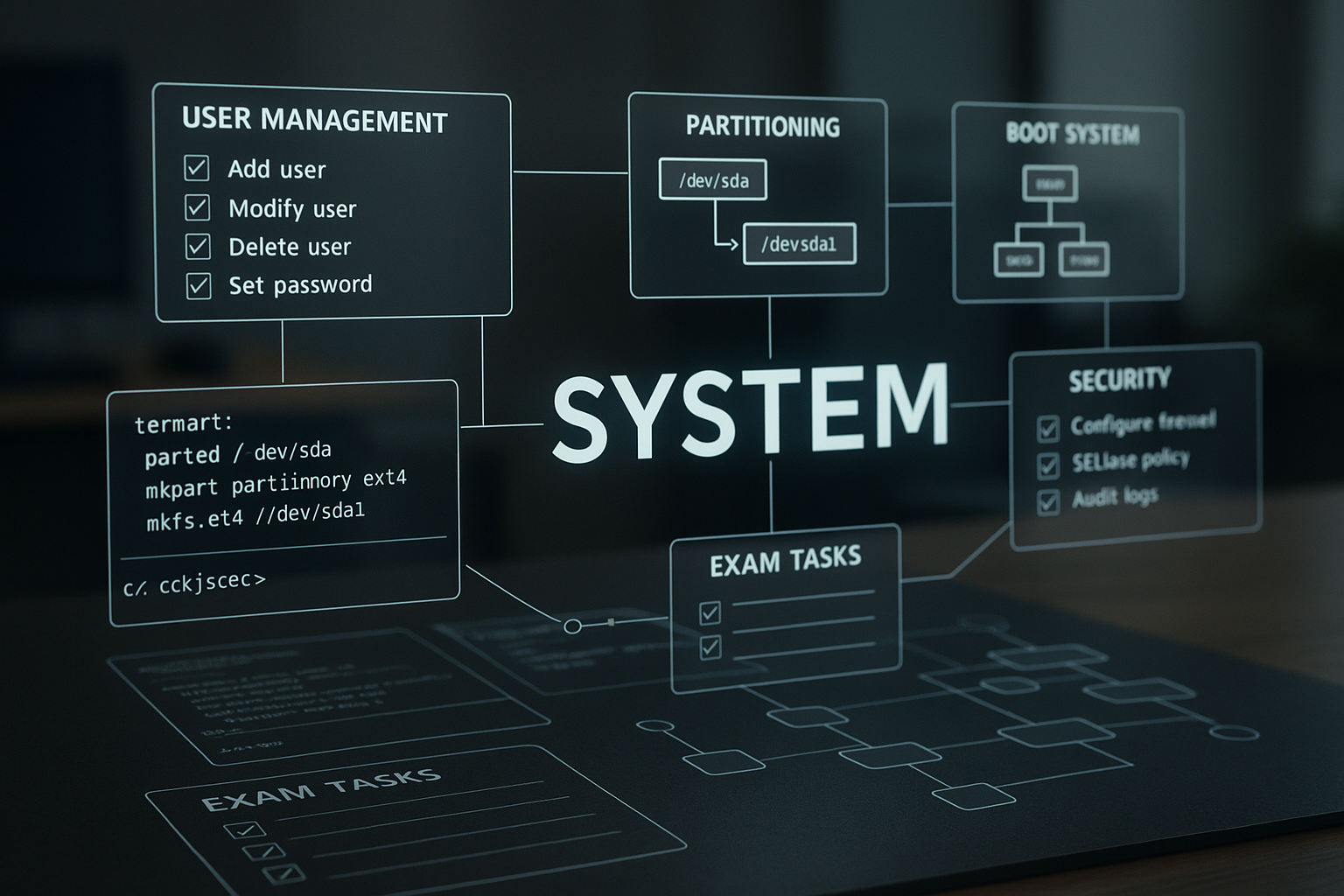
This course builds on foundational Linux administration skills, enabling participants to manage and automate tasks in Red Hat Enterprise Linux environments. It introduces essential topics such as shell scripting, storage configuration, and system security, empowering them to support complex systems with confidence.
Learning Outcomes:
Apply shell scripting and automation techniques to streamline administrative tasks
Configure advanced storage using volumes, partitions, and file systems
Manage users, processes, and security in enterprise environments
Troubleshoot boot processes, services, and SELinux
Implement network configurations and performance monitoring
Key Topics:
Bash scripting and command-line automation
Logical volume management and file system tuning
Process control, user permissions, and access policies
Network configuration and troubleshooting
Systemd targets, SELinux, and GRUB bootloader
Exam Details
This course is designed to build participants’ understanding of key competencies covered in the Red Hat Certified System Administrator (RHCSA) certification.
It forms the second part of the RHCSA training track and focuses on practical skills including scalable installation, command-line automation, managing system access, SELinux policies, system boot processes, and container operations — all of which align with the RHCSA exam domains.
Participants who are experienced Linux administrators and intend to fast-track their certification journey are advised to consider the RHCSA Rapid Track (RH199).
To maximise success, participants are strongly encouraged to complement the course with additional self-study, revision of course materials, and dedicated practice before attempting the exam.
Improve command line productivity
Run commands more efficiently by using advanced features of the Bash shell, shell scripts, and various utilities provided by Red Hat Enterprise Linux.
Schedule future tasks
Schedule commands to run in the future, either one time or on a repeating schedule.
Tune system performance
Improve system performance by setting tuning parameters and adjusting scheduling priority of processes.
Manage SELinux security
Protect and manage the security of a server by using SELinux.
Manage logical volumes
Create and manage logical volumes containing file systems and swap spaces from the command line.
Access network-attached storage
Use the NFS protocol to administer network-attached storage.
Control the boot process
Manage the boot process to control services offered and to troubleshoot and repair problems.
Manage network security
Control network connections to services using the system firewall and SELinux rules.
Install Red Hat Enterprise Linux
Install Red Hat Enterprise Linux on servers and virtual machines.
Run Containers
Obtain, run, and manage simple, lightweight services as containers on a single Red Hat Enterprise Linux server.
We’re here to help — reach out anytime.
By submitting this form, you consent to be contacted via email and/or your mobile number regarding your enquiry. You consent to the collection, use, disclosure and processing of your personal data in accordance with our Personal Data Policy.




.png?width=50&name=Artificial%20Intelligence%20(AI).png)


/AdobeStock_230441943.jpeg?width=360&name=AdobeStock_230441943.jpeg)

/AdobeStock_737314510.jpeg?width=360&name=AdobeStock_737314510.jpeg)






/AI%20(5)-1.png?width=360&name=AI%20(5)-1.png)









































































-1.png?width=360&name=Server%20(4)-1.png)





/AI%20(6)-1-1.png?width=360&name=AI%20(6)-1-1.png)
/AI%20(8)-1.png?width=360&name=AI%20(8)-1.png)
-1.png?width=360&name=Automation%20RPA%20(2)-1.png)




















































![VMware vRealize Operations: Install, Configure, Manage [V8.6]](https://www.eservtraininghub.com/hs-fs/hubfs/331_result.jpg?width=360&name=331_result.jpg)
![VMware vRealize Automation - Install, Configure, Manage [V8.3]](https://www.eservtraininghub.com/hs-fs/hubfs/AI-Generated%20Media/Images/Automation%20system%20deploying%20infrastructure%20in%20realtime%20with%20robotic%20arms%20and%20config%20lines%20building%20digital%20components%20Blue%20enterprise%20tech%20setting.jpeg?width=360&name=Automation%20system%20deploying%20infrastructure%20in%20realtime%20with%20robotic%20arms%20and%20config%20lines%20building%20digital%20components%20Blue%20enterprise%20tech%20setting.jpeg)















































![VMware vSphere: Install, Configure, Manage [V8]](https://www.eservtraininghub.com/hs-fs/hubfs/756_result.jpg?width=360&name=756_result.jpg)









![VMware NSX: Install, Configure, Manage [V4.0]](https://www.eservtraininghub.com/hs-fs/hubfs/812_result.jpg?width=360&name=812_result.jpg)