*Important Note : Fees are subject to Singapore's prevailing Goods and Services Tax (GST).
1752451200000
60

Cloud & Infrastructure
Cybersecurity & Risk Management
Artificial Intelligence & Automation
Data Analytics & Data Science
Digital Skills & Office Productivity
Project Management & Agile
Software Development & IT Ops
Critical Core Skills
Maritime
Cloud & Infrastructure
Cybersecurity & Risk Management
Artificial Intelligence & Automation
Data Analytics & Data Science
Digital Skills & Office Productivity
Project Management & Agile
Software Development & IT Ops
Critical Core Skills
Maritime
 Programming

Enrol now and save $0 on your course fee
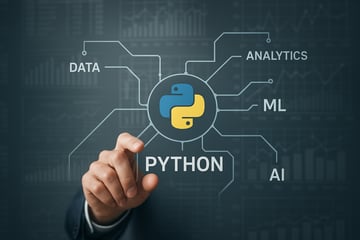
Python is a core language for today’s data-driven roles. This hands-on bootcamp equips participants with end-to-end Python skills, from syntax to file operations and data processing. They will work on structured exercises and mini-projects to gain practical fluency.
Learning Outcomes:
Understand core Python programming constructs
Write scripts using variables, loops, and functions
Handle files and exceptions in Python
Manipulate data using built-in libraries
Key Topics:
Python syntax, logic, and expressions
Data structures and control flow
File handling and exception management
Modules, libraries, and data formatting
DAY 1
Module 1 - Foundations of Python
The aim of the module is to get the participants familiar with the basics of the Python integrated development environment, the nuances of python scripting, basic operational functionalities and control structure used. This is an integral part of Python since it lays the foundation for participants to be able to code simple and complex programs.
• Getting Ready – Install all required software and libraries and understand the Python IDE
• Basics of Python Scripting • Data Types (Numbers, String, List, Tuple, Dictionary, Set, Data frames)
• Operators (Arithmetic, Compound, Comparison, Membership, Logical, Identity)
Module 2 : Functions and Control Flow
This module deals with conditional statements and control flow which helps in creating programs with decisions. Having modular code is one of the best practices of any programming language, especially Python. In this module you will also learn how to create modular code using functions.
• Functions (Function syntax, Return value, Return multiple values, Passing argument values, Default argument values, Variable argument sequence)
• Control Structure (Conditional, Loop, Iterating Over Multiple Sequences, Break & Continue)
Module 3 : Object Oriented Programming Concepts and Working with Files
The objective of the module is to get the participants familiar with the OOP concepts within Python and working with files. Through this, the participants will learn how to work with external data sources, be it files or databases and also to write reusable codes on Jupyter and how it is useful as a presentation tool.
• Classes, Methods, Attributes
• File I/O and the Operations on Files Regular Expressions Practice Project and Presentation
DAY 2
Module 4 : Python Libraries, Web Scraping and Dealing with APIs
This module will help you understand two of the most important libraries in python which are required for most operations: numpy (numerical python) and pandas (data manipulation). These libraries will help you code more complex programs. It will also cover an important concept which involves use of scrapers to source data from the www and using APIs which are a critical part of any programming language.
• Basics of Numpy and Pandas
• Operations using Numpy and Pandas
• Basics of Web Scraping
• Using APIs to get and use data
Module 5 : Understanding Data
To learn how to get data from external sources into the Python environment and manipulate and analyze data. Before any data analytics project, it is very important to use statistical algorithms and methods to analyze data as part of the data analytics process.
• Introduction to python packages for data manipulation
• Importing and exporting data
• Importing datasets and understanding data
• Basics of analyzing the data
Module 6 : Data Wrangling
To learn about how python libraries can be leveraged to deal with data inconsistencies, issues with data and making them fit for data analytics. This is where 80% of today’s data scientists and engineers spend their time and it if very important to know how to do it.
• Dealing with data issues and preparation in Python
• Data Formatting and conversions in Python
• Data Wrangling
• Working with Pandas in detail
Practice Project and Presentation
DAY 3
Module 7 : Model Development for Analysis
This module gives the participants the very first steps towards forming hypothesis and doing predictive analytics. It aims to equip participants with the basics of how supervised machine learning models work and how evaluation and optimization can be carried out.
• Simple Linear Regression
• Model Evaluation Methods
Module 8 : Data Visualization
The objective of this module is to understand basic metric and KPIs (Key Performance Indicators) of different business cases and plotting advanced interactive visualizations for data analysis to gain insights from data.
• Understanding basic metrics and KPIs
• Visualizations using Python (Seaborn, Folium)
We’re here to help — reach out anytime.
By submitting this form, you consent to be contacted via email and/or your mobile number regarding your enquiry. You consent to the collection, use, disclosure and processing of your personal data in accordance with our Personal Data Policy.



.png?width=50&name=Artificial%20Intelligence%20(AI).png)


/AdobeStock_230441943.jpeg?width=360&name=AdobeStock_230441943.jpeg)

/AdobeStock_737314510.jpeg?width=360&name=AdobeStock_737314510.jpeg)






/AI%20(5)-1.png?width=360&name=AI%20(5)-1.png)





































































-1.png?width=360&name=Server%20(4)-1.png)





/AI%20(6)-1-1.png?width=360&name=AI%20(6)-1-1.png)
/AI%20(8)-1.png?width=360&name=AI%20(8)-1.png)
-1.png?width=360&name=Automation%20RPA%20(2)-1.png)





















































![VMware vRealize Operations: Install, Configure, Manage [V8.6]](https://www.eservtraininghub.com/hs-fs/hubfs/331_result.jpg?width=360&name=331_result.jpg)
![VMware vRealize Automation - Install, Configure, Manage [V8.3]](https://www.eservtraininghub.com/hs-fs/hubfs/AI-Generated%20Media/Images/Automation%20system%20deploying%20infrastructure%20in%20realtime%20with%20robotic%20arms%20and%20config%20lines%20building%20digital%20components%20Blue%20enterprise%20tech%20setting.jpeg?width=360&name=Automation%20system%20deploying%20infrastructure%20in%20realtime%20with%20robotic%20arms%20and%20config%20lines%20building%20digital%20components%20Blue%20enterprise%20tech%20setting.jpeg)














































![VMware vSphere: Install, Configure, Manage [V8]](https://www.eservtraininghub.com/hs-fs/hubfs/756_result.jpg?width=360&name=756_result.jpg)








![VMware NSX: Install, Configure, Manage [V4.0]](https://www.eservtraininghub.com/hs-fs/hubfs/812_result.jpg?width=360&name=812_result.jpg)