.png?width=22&height=21&name=Artificial%20Intelligence%20(AI).png)

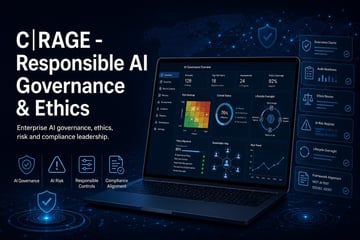
As organisations adopt artificial intelligence across products, services, operations and decision-making, they need governance approaches that support innovation while maintaining accountability, transparency and trust. Effective AI governance helps organisations manage the opportunities and risks associated with AI, establish appropriate oversight and ensure that AI remains aligned with business objectives and organisational responsibilities.
This course provides practical guidance for governing AI responsibly using the ITIL AI Capability Model and ITIL AI Governance Improvement Model. Participants will examine how AI affects organisational activities, assess governance readiness, define appropriate governance requirements and support the implementation and continual improvement of AI governance. The course also explores AI-related risks, human oversight, regulatory considerations and the integration of AI governance with other frameworks and organisational practices.
Learning Outcomes
Upon completion of this course, participants will be able to:
- Understand how AI governance helps organizations adopt AI responsibly, manage risk, and build trust with stakeholders.
- Explain core AI concepts, AI types, and the ITIL AI Capability Model in clear business language that supports better decision-making.
- Identify practical opportunities for AI to create value across business functions while recognizing the risks, trade-offs, and governance implications involved.
- Assess common AI risks, ethical concerns, and control measures, and translate them into governance actions that can be applied in real working environments.
- Use the ITIL AI Governance Improvement Model to review current practices, define governance requirements, test controls, implement improvements, and support ongoing assurance.
- Strengthen accountability, oversight, and decision-making across AI initiatives, suppliers, third parties, and operational teams.
- Balance innovation, ethics, compliance, and speed so AI initiatives can scale responsibly without losing business momentum.
- Apply practical tools, language, and guidance to improve AI governance immediately and turn AI ambition into measurable, sustainable value.
Key Topics
- ITIL, artificial intelligence and governance fundamentals
- AI opportunities, risks, accountability and human oversight
- The ITIL AI Capability Model
- The ITIL AI Governance Improvement Model
- Regulation, compliance and alignment with other frameworks
Exam Details
The course includes the ITIL AI Governance (Version 5) certification exam bundled with the course fee. Participants will receive an exam voucher for a webcam-proctored online examination conducted via the PeopleCert platform.
| Exam duration | 90 minutes |
| Number of questions | 40 |
| Question format | Multiple choice |
| Pass mark | 70% |
| Open book | Yes |
| Delivery format | Webcam-proctored online exam |
To maximise success, participants are strongly encouraged to complement the course with additional self-study, revision of course materials, and dedicated practice before attempting the exam.
ITIL® is a registered trademark of the PeopleCert group. Used under licence from PeopleCert. All rights reserved.
Module 1: The AI Environment and the Need for Governance
- Introduction to artificial intelligence
- The growing use of AI across organisations
- Opportunities and benefits associated with AI
- Risks and challenges introduced by AI
- The purpose and importance of AI governance
- Key AI governance terms and concepts
Module 2: Understanding Governance
- The meaning and purpose of governance
- Governance, management and leadership
- Governance structures and responsibilities
- Accountability and decision-making
- Governance within an organisational context
- The relationship between governance and organisational objectives
Module 3: Understanding AI and What Can Be Governed
- Different types and uses of AI
- Key characteristics of AI systems
- AI-enabled products, services and organisational activities
- AI-supported operations and decision-making
- AI capabilities and limitations
- Identifying AI-related governance requirements
Module 4: AI Capabilities, Risks and Controls
- The ITIL AI Capability Model
- Organisational capabilities that influence AI adoption and use
- AI-related risk categories and governance challenges
- Accountability, transparency and trust
- Ethical safeguards and human oversight
- Proportionate risk treatment and governance controls
- The consequences of ineffective AI governance
Module 5: ITIL as an AI Governance Toolkit
- ITIL principles relevant to AI governance
- Applying ITIL guidance to AI-enabled products and services
- AI across the product and service lifecycle
- AI-enabled activities within organisational value chains
- Governance considerations for automation
- Using existing organisational capabilities to support AI governance
Module 6: Assessing and Designing AI Governance Improvements
- Introduction to the ITIL AI Governance Improvement Model
- Assessing AI governance capabilities and readiness
- Establishing the current governance baseline
- Stress-testing governance arrangements
- Identifying gaps, risks and improvement priorities
- Defining governance requirements
- Designing appropriate governance adjustments
- Selecting governance patterns for different organisational contexts
Module 7: Implementing and Maintaining AI Governance
- Implementing AI governance adjustments
- Establishing roles, responsibilities and accountabilities
- Embedding governance across organisational activities
- Maintaining the AI governance system
- Monitoring governance performance and effectiveness
- Governance assurance and observability
- Continual improvement of AI governance capabilities
- Maintaining alignment with organisational objectives
Module 8: Applying AI Governance Across the Organisation
- AI use across industries and organisational functions
- AI governance across products, services, projects and programmes
- Governance considerations for organisational workflows
- Applying governance to AI-enabled operations and decisions
- Addressing shadow AI and unapproved AI use
- Maintaining meaningful human control over AI outcomes
- Applying governance principles to practical workplace scenarios
Module 9: Regulation, Standards and Other Frameworks
- How regulatory requirements shape AI governance
- Compliance responsibilities and external obligations
- Governance considerations for data protection and ethical AI use
- Alignment with organisational policies and controls
- Integrating the ITIL AI governance approach with other frameworks
- Supporting consistent governance across different methods and standards
- Applying governance requirements in an evolving regulatory environment







.png?width=50&name=Artificial%20Intelligence%20(AI).png)







/AI%20(5)-1.png?width=360&name=AI%20(5)-1.png)







































































-1.png?width=360&name=Server%20(4)-1.png)






/AI%20(6)-1-1.png?width=360&name=AI%20(6)-1-1.png)
/AI%20(8)-1.png?width=360&name=AI%20(8)-1.png)
-1.png?width=360&name=Automation%20RPA%20(2)-1.png)