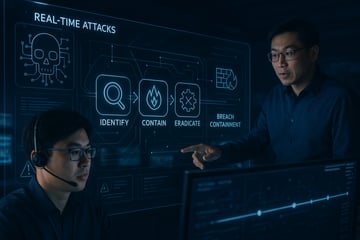
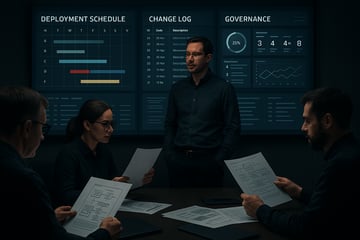
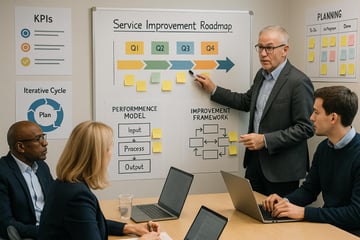
Effective information security leadership hinges on strategic oversight, risk management, business alignment, and an understanding of the enterprise architecture and technologies under a security manager’s purview. This course prepares participants to design, implement, manage, and evaluate enterprise information security programmes that support organisational goals. Through scenario-based learning, participants will explore governance frameworks, information security strategy, enterprise and security architecture, risk response, compliance obligations, programme development, and incident management.
Learning Outcomes:
-
Understand key principles of enterprise information security governance
-
Evaluate and manage information security risk
-
Design and implement information security programmes
-
Develop incident response and recovery plans
Key Topics:
-
Information security governance and strategy
-
Enterprise and information security architecture
-
Risk assessment, treatment, monitoring, and reporting
-
Information security programme design, implementation, and metrics
-
Incident management, business continuity, and disaster recovery
-
Preparation for ISACA® Certified Information Security Manager (CISM) certification
Exam Details
This course is aligned with the updated ISACA Certified Information Security Manager (CISM) Exam Content Outline effective from 3 November 2026. It is designed to build participants’ understanding of the key concepts, job practice areas and four domains covered in the ISACA Certified Information Security Manager (CISM) certification examination.
The CISM exam evaluates participants across four domains:
| Domain | Weightage |
|---|---|
| Domain 1 – Information Security Governance | 18% |
| Domain 2 – Information Security Risk Management | 20% |
| Domain 3 – Information Security Program | 33% |
| Domain 4 – Incident Management | 29% |
Please note that the course fee does not include the certification exam. Exam registration must be done separately via ISACA.
To maximise success, participants are strongly encouraged to complement the course with additional self-study, revision of course materials, and dedicated practice before attempting the exam.
FUNDING INFORMATION
SkillsFuture Singapore (SSG)
Funding is available on Course Fee. Please see below for the eligibility categories available.
| Self-sponsored | Singapore Citizen & PR aged ≥ 21 years | Up to 50% funding |
| Singapore Citizen aged ≥ 40 years | Up to 70% funding | |
| Company Sponsored (Non-SME) | Singapore Citizen & PR aged ≥ 21 years | Up to 50% funding |
| Singapore Citizen aged ≥ 40 years | Up to 70% funding | |
| Company Sponsored (SME) | Singapore Citizen & PR aged ≥ 21 years | Up to 70% funding |
| Singapore Citizen aged ≥ 40 years | Up to 70% funding |
SSG Funding Requirements
- Trainees must scan their attendance twice daily using the SingPass application.
- Trainees must attain at least 75% attendance.
- Trainees must pass the in-house assessment to be eligible for funding.
- Trainee and/or sponsoring company is/are required to meet all SSG-mandated eligibility criteria and requirements for funding. For more information, please refer to SkillsFuture homepage.
Appeal Policy and Procedure
- As a candidate in this course assessment, you may appeal your results if you disagree with them.
- To do so, submit your written appeal request via email to esv_comat_cse@stengg.com within 3 working days from date of assessment.
Cancellation, Postponement and Refund Policy
- Request for cancellation or postponement must be submitted in writing more than 4 weeks before the class start date to avoid any charges.
- Written notice for cancellation or postponement received 2 to 4 weeks before class start date will incur Late Cancellation Charge - 50% of course fee.
- Written notice for cancellation or postponement received less than 2 weeks before class start date will incur Late Cancellation Charge - 100% of course fee.
- If payment has been made and ST Engineering e-Services Pte Ltd accepts the trainee's written notification to cancel or withdraw from the course, ST Engineering e-Services Pte Ltd will issue a refund, less any applicable Late Cancellation Charges.
Feedback Policy and Procedure
- You may submit feedback via email to esv_comat_cse@stengg.com or your servicing Account Manager.
- Any formal feedback will be handled within 10 working days from receipt with a written reply given. An interim reply will be provided should more time be required.
Domain 1 - Information Security Governance
Learning Objectives:
- Describe the role of governance in creating value for the enterprise.
- Explain the importance of information security governance in the context of overall enterprise governance.
- Identify the relevant legal, regulatory, and contractual requirements that impact the enterprise.
- Describe the influence of enterprise leadership, structure, and culture on the effectiveness of an information security strategy.
- Describe the effects of the information security strategy on enterprise risk management.
- Explain the relationship between enterprise architecture (EA) and effective enterprise governance.
- Evaluate the common frameworks and standards used to govern an information security strategy.
- Explain why metrics are critical in developing and evaluating the information security strategy.
Topics:
- Organizational Purpose and Culture
- Legal, Regulatory, and Contractual Requirements
- Organizational Structures, Roles, and Responsibilities
- Information Security Strategy Development
- Enterprise Architecture
- Information Governance Frameworks and Standards
- Strategic Planning
Domain 2 – Information Security Risk Management
Learning Objectives:
- Apply risk assessment strategies to reduce the impact of information security risk.
- Assess the types of threats faced by the enterprise.
- Explain how security control baselines affect vulnerability and control deficiency analysis.
- Differentiate between the application of risk treatment types from an information security perspective.
- Describe the influence of risk and control ownership on the information security program.
- Outline the process of monitoring and reporting information security risk.
Topics:
- Emerging Risk and Threat Landscape
- Vulnerability and Control Deficiency Analysis
- Risk Assessment and Analysis
- Risk Treatment/Risk Response Options
- Risk and Control Ownership
- Risk Monitoring and Reporting
Domain 3 – Information Security Program
Learning Objectives:
- Describe the goals and objectives of an information security architecture.
- Outline the components and resources used to build an information security program.
- Distinguish between common information security standards and frameworks available for building an information security program.
- Explain how to align information security policies, procedures, and guidelines with the needs of the enterprise.
- Describe the process of defining an information security program road map.
- Outline key information security program metrics used to track and report progress to senior management.
- Explain how to manage the information security program using controls.
- Create a strategy to enhance awareness and knowledge of the information security program.
- Describe the process of integrating the security program with IT operations and third-party providers.
- Communicate key security program information to relevant stakeholders.
Topics:
- Information Security Architecture
- Information Security Program Resources
- Information Security Industry Standards and Frameworks
- Information Security Policies, Standards, Procedures, and Guidelines
- Information Asset Identification and Classification
- Information Security Control Design and Selection
- Information Security Program Metrics Development
- Information Security Control Implementation and Integrations
- Information Security Control Testing and Evaluation
- Information Security Awareness and Training
- Management of External Services
- Information Security Program Metrics, Communications, and Reporting
Domain 4 – Incident Management
Learning Objectives:
- Distinguish between incident management and incident response.
- Outline the requirements and procedures necessary to develop an incident response plan.
- Explain the relationship between business impact, continuity, and incident response.
- Describe the processes and outcomes related to disaster recovery.
- Explain the impact of metrics and testing when evaluating the incident response plan.
- Identify techniques used to classify or categorize incidents.
- Outline the types of roles and responsibilities required for an effective incident management and response team.
- Distinguish between the types of incident management tools and technologies available to an enterprise.
- Describe the processes and methods used to investigate, evaluate, and contain an incident.
- Identify the types of communications and notifications used to inform key stakeholders of incidents and tests.
- Outline the processes and procedures used to eradicate and recover from incidents.
- Describe the requirements and benefits of documenting events.
Topics:
- Incident Response Plan
- Business Impact Analysis (BIA)
- Business Continuity Plan (BCP)
- Disaster Recovery Plan (DRP)
- Incident Classification/Categorization
- Incident Management Training, Testing, and Evaluation
- Incident Management Tools and Techniques
- Incident Investigation and Evaluation
- Incident Containment Methods
- Incident Response Communications
- Incident Eradication and Recovery
- Post-incident Review Practices




.png?width=50&name=Artificial%20Intelligence%20(AI).png)







/AI%20(5)-1.png?width=360&name=AI%20(5)-1.png)







































































-1.png?width=360&name=Server%20(4)-1.png)





/AI%20(6)-1-1.png?width=360&name=AI%20(6)-1-1.png)
/AI%20(8)-1.png?width=360&name=AI%20(8)-1.png)
-1.png?width=360&name=Automation%20RPA%20(2)-1.png)