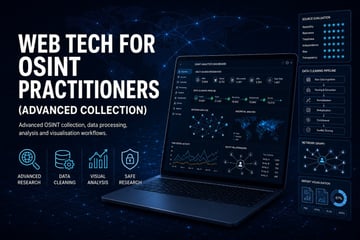
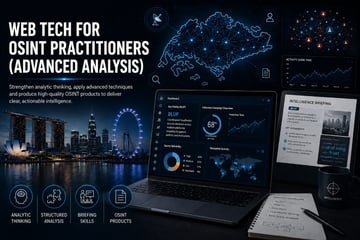
Module 1: Introduction to Open-Source Intelligence (OSINT)
- Understand the concept and scope of OSINT
- Explore real-world applications in journalism, cybersecurity, and personal safety
- Recognise how OSINT helps in spotting misinformation and disinformation as part of a broader digital literacy strategy
- Learn about career opportunities as an OSINT analyst
Module 2: Understanding Your Digital Footprint
- Recognise how personal data is collected and exposed online through cookies, ads, trackers, and third-party scripts
- Understand the role of data brokers and how they aggregate and sell personal information
- Learn the risks of oversharing on social media and other platforms, and how this can be exploited
- Discover how credentials are leaked, including passwords guessed using publicly available personal information, data breaches from insecure websites or reused passwords and phishing attacks that trick users into revealing login details.
- Understand the impact of credential leaks, such as identity theft and financial fraud, unauthorised access to personal or corporate accounts, damage to reputation or professional relationships and long-term exposure in dark web marketplaces
Module 3: Protecting Your Personal Details and Privacy in Everyday Life
- Learn basic strategies to protect privacy and reduce digital footprints in everyday online activities
- Understand the importance of browser hygiene, including clearing cookies, managing trackers, and using private browsing modes
- Practice strong password management, including the use of password managers and multi-factor authentication (MFA)
- Explore privacy-enhancing tools and browser extensions, such as ad blockers, anti-tracking tools, and script blockers
- Introduce the use of Virtual Private Networks (VPNs) to encrypt internet traffic and protect online activity from surveillance and tracking
- Understand key internet fundamentals to make safer online decisions e.g. IPv4 vs. IPv6, HTTP vs. HTTPS and domain types (.com, .org, .net, .io, etc.)
Module 4: Spotting Misinformation and Disinformation
- Understand the difference between misinformation and disinformation
- Learn how false information spread online and how to stop them
- Apply the S.U.R.E. (Source, Understand, Research, Evaluate) framework to verify content.
(The S.U.R.E. framework is part of a national digital literacy campaign by the National Library Board (NLB) of Singapore, aimed at helping individuals become discerning information consumers)
- Use tools to determine if a website or message can be trusted, including checking domain details, trust scores, and scam reports
Module 5: Effective Use of Search Engines for OSINT
- Learn how to use different search engines effectively for OSINT investigations
- Understand the difference between basic and advanced search techniques such as basic keyword search involves entering simple terms or phrases (e.g., climate change news) and relying on the search engine’s default ranking and advanced search uses Boolean operators (AND, OR, NOT), quotation marks, site-specific queries (site:example.com), and Google Dorking to uncover more precise, hidden, or indexed data.
- Apply advanced search techniques to extract deeper insights, such as utilise Google Dorking to uncover more precise, hidden, or indexed data, such as finding exposed documents (filetype:pdf confidential) and using time filters and cache views for historical data
- Understand how different search engines index and prioritise content, and how to leverage their strengths (e.g., Google for breadth, DuckDuckGo for privacy, Yandex for image search).
(Note: A comparison table will be provided to break down the strengths and ideal use cases, and global usage rankings of each major search engine e.g. Google, Bing, DuckDuckGo, Yandex, Brave Search) to help participants choose the right tool for the task
Module 6: Performing Your Own Social Media Investigations
- Investigate usernames and hashtags to uncover digital footprints and behavioural patterns
- Link social media activity across platforms by identifying reuse of the same username across multiple platforms, matching profile pictures and shared or reused email addresses and phone numbers (paid tools)
- Apply OSINT tools for purposes such as digital parenting, personal safety, or background checks
- Understand where Singaporeans consume information, and which platforms are most relevant for investigations
Module 7: Investigating Locations through OSINT
- Introduce the basics of investigating locations using digital maps and street-level imagery, and location-based social media clues
- Learn techniques for identifying, verifying, and tracking places using street-level views, photo metadata and location-based hashtags (e.g., #orchardroad, #sentosaisland)
- Show how everyday people can use these tools to check if online content is real, plan safe travel and spot fake or scam property listings
- Raise awareness of how location data can be both a powerful tool and a privacy concern
Module 8: Scam prevention through OSINT investigation
- Investigate unknown or suspicious phone numbers and email addresses using free OSINT tools and techniques
- Understand how phone numbers and email domains can be linked to online identities, scam networks, and impersonation attempts
- Identify red flags in email domains (e.g., typosquatting, free email providers, spoofed domains)
- Verify the legitimacy of calls, messages, and emails to avoid fraud and protect personal information
- Learn about phone number metadata, country codes, and caller ID spoofing tactics used in scams
- Understand what URL shorteners are, why scammers use them, and how to verify shortened links safely

 Cybersecurity






.png?width=50&name=Artificial%20Intelligence%20(AI).png)


/AdobeStock_230441943.jpeg?width=360&name=AdobeStock_230441943.jpeg)

/AdobeStock_737314510.jpeg?width=360&name=AdobeStock_737314510.jpeg)






/AI%20(5)-1.png?width=360&name=AI%20(5)-1.png)







































































-1.png?width=360&name=Server%20(4)-1.png)






/AI%20(6)-1-1.png?width=360&name=AI%20(6)-1-1.png)
/AI%20(8)-1.png?width=360&name=AI%20(8)-1.png)
-1.png?width=360&name=Automation%20RPA%20(2)-1.png)


















































![VMware vRealize Operations: Install, Configure, Manage [V8.6]](https://www.eservtraininghub.com/hs-fs/hubfs/331_result.jpg?width=360&name=331_result.jpg)
![VMware vRealize Automation - Install, Configure, Manage [V8.3]](https://www.eservtraininghub.com/hs-fs/hubfs/AI-Generated%20Media/Images/Automation%20system%20deploying%20infrastructure%20in%20realtime%20with%20robotic%20arms%20and%20config%20lines%20building%20digital%20components%20Blue%20enterprise%20tech%20setting.jpeg?width=360&name=Automation%20system%20deploying%20infrastructure%20in%20realtime%20with%20robotic%20arms%20and%20config%20lines%20building%20digital%20components%20Blue%20enterprise%20tech%20setting.jpeg)















































![VMware vSphere: Install, Configure, Manage [V8]](https://www.eservtraininghub.com/hs-fs/hubfs/756_result.jpg?width=360&name=756_result.jpg)







![VMware NSX: Install, Configure, Manage [V4.0]](https://www.eservtraininghub.com/hs-fs/hubfs/812_result.jpg?width=360&name=812_result.jpg)